PASEC2024 · Data collected in 2025
In high school, fundamental skills that are still insufficiently mastered
What do students actually master after nine or ten years of schooling? For the first time, PASEC2024 documents reading and mathematics skills at the end of secondary school in 14 countries, highlighting disparities between students and schools.
Disponible en
- French
- English (Coming soon) Bientôt disponible
- Portuguese (Coming soon) Bientôt disponible
What needs to be remembered
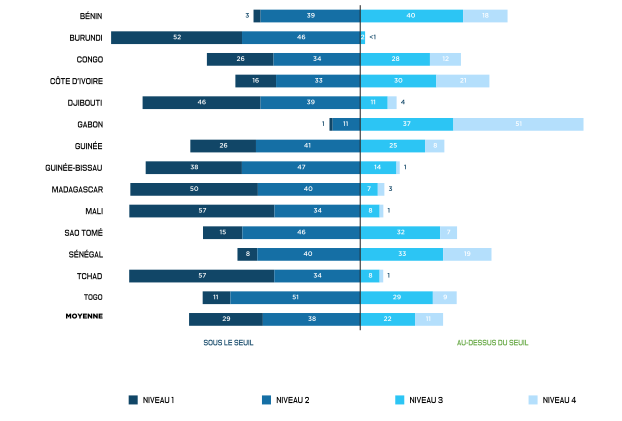
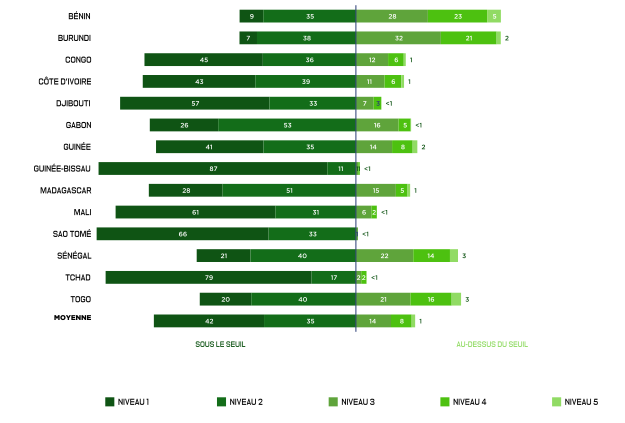
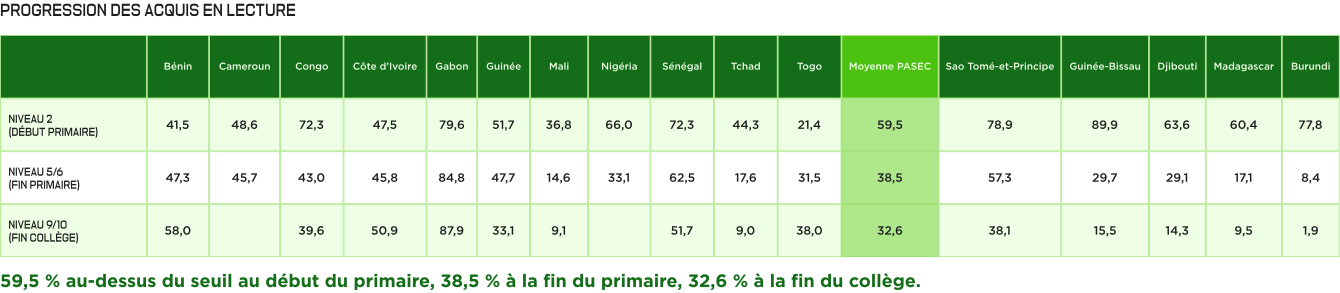
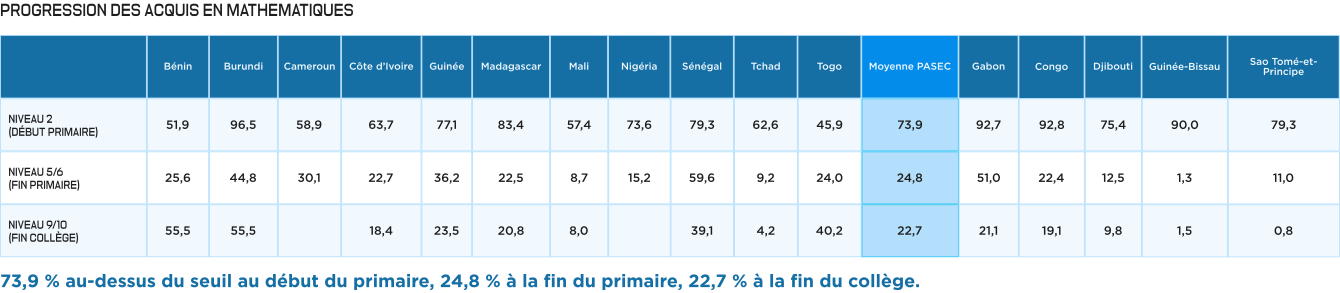
At the end of nine or ten years of schooling, only 32.7 % of the students reach the minimum threshold of reading skills and 22.6 % in mathematics. A significant proportion of the students have not consolidated what was expected at the end of primary school.
-
32,7 %
Students above the reading threshold at the end of high school
-
22,6 %
Students above the threshold in mathematics at the end of high school
-
42,2 %
Students at level 1 in mathematics
-
14 countries
Countries with results in the secondary school level
Three key messages
-
Still poorly mastered minimum skills
Only one in three students has mastered the minimum skills in reading, and less than one in four in mathematics.
-
Reading and mathematics do not tell the same story
The diagnosis is not the same across disciplines; one system may succeed in one and fail in the other.
-
Difficulties already visible upstream
The main theme emphasizes one point: the problem is not access to school, but the way in which the skills acquired in primary school deteriorate before reaching the high school level.
Graphs to remember
-
Distribution of students by country in the four levels of reading proficiency
-
Distribution of students by country and by level of proficiency in mathematics
-
Trajectory of the acquired skills throughout the course
Part of students above the expected minimum level
-
Source: PASEC (2026). PASEC2024 – Assessment of students’ skills at the end of secondary school in sub-Saharan Africa. CONFEMEN.
The historical evolution chart only compares the countries and scales for which comparability has been established. You can select 2019–2025 or 2014–2025 in the explorer.
Access the explorerHow to interpret These data
Competence levels have definitions specific to the data and populations studied. Comparisons between countries or editions require methodological precautions.
Reference frameworks
Methodological documents of the PASEC2024 evaluation.
-
Beginning of primary school
-
End of primary school
-
End of high school
-
Teachers
-
Questionnaires
Manuals and methodological tools
Methodological documents of the PASEC2024 evaluation.
-
Manual for the national responsible
-
Sampling manual
-
Classification and codification
-
Data cleaning manual
Access to the databases PASEC2024 data
The use of the data is the sole responsibility of the user. CONFEMEN cannot be held responsible for any use that does not comply with the commitments signed.