PASEC2024 · Data collected in 2025
In primary school, Acquiring knowledge struggles to be consolidated throughout schooling
What do students know at the beginning of primary school, and what do they master at the end of the cycle? The PASEC 2024 assessment sheds light on the levels of proficiency in language, reading, and mathematics, the disparities between students, and the developments observed since previous editions.
Disponible en
- French
- English (Coming soon) Bientôt disponible
- Portuguese (Coming soon) Bientôt disponible
What needs to be remembered
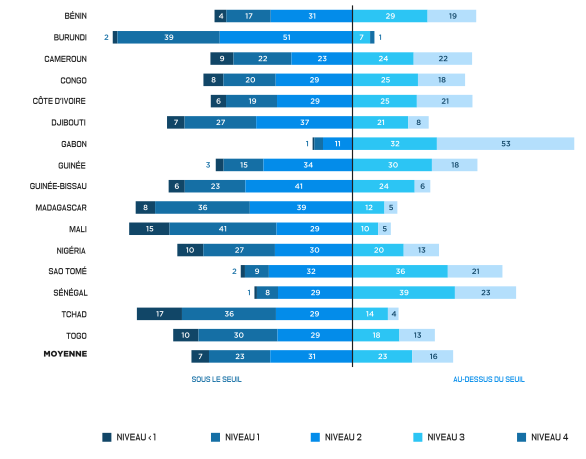
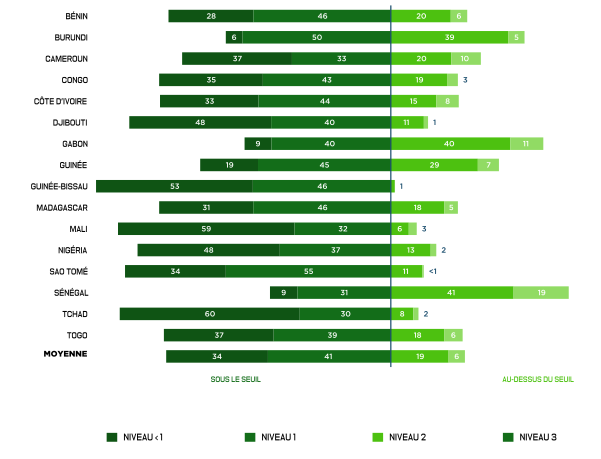
In primary school, the difficulty does not diminish as the school year progresses: it worsens. At the beginning of the school year, nearly six out of ten students master the expected knowledge in the language of instruction, and nearly three-quarters in mathematics; at the end of the cycle, there are only 38.5 % in reading and 24.8 % in mathematics.
-
59,5 %
Students above the threshold in language at the beginning of primary school
-
38,5 %
Students above the reading threshold at the end of primary school
-
73,6 %
Students above the threshold in mathematics at the beginning of primary school
-
24,8 %
Students above the threshold in mathematics at the end of primary school
Three key messages
-
Fundamental gains still fragile
The majority of students complete primary school without mastering the basic skills, especially in mathematics.
-
The level progresses at the beginning of schooling and then declines at the end.
Between 2019 and 2025, several countries make progress at the beginning of the cycle, but none makes progress in reading at the end of primary school and seven decline.
-
Inequalities remain strong
Social origin, the place of schooling, public/private status, and the language spoken at home all have a strong impact on results, with significant variations between countries.
Graphs to remember
-
Distribution of students by level of written comprehension proficiency at the end of primary schooling (%)
-
Distribution of students by level of proficiency in mathematics at the end of primary schooling (%)
-
Reading trends between 2014 and 2025 at the beginning of schooling
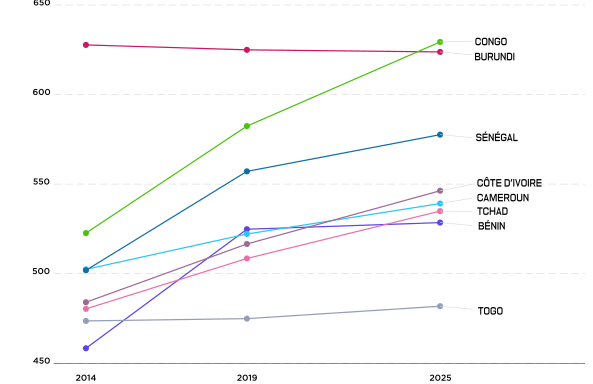
Source: PASEC (2026). PASEC2024 – Summary of primary learning achievements in sub-Saharan Africa. CONFEMEN.
-
Evolution of skills at the end of schooling between 2014 and 2025
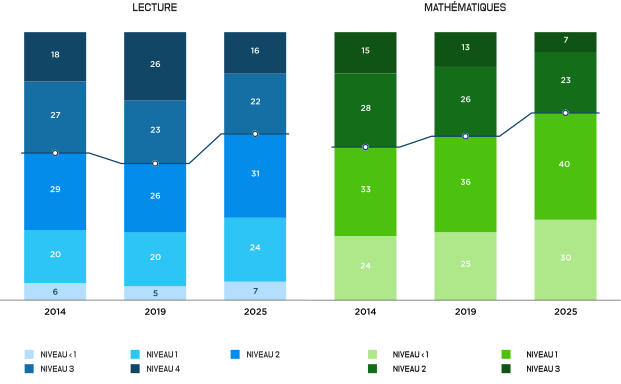
The historical evolution chart only compares the countries and scales for which comparability has been established. You can select 2019–2025 or 2014–2025 in the explorer.
Access the explorerHow to interpret These data
Competence levels have definitions specific to the data and populations studied. Comparisons between countries or editions require methodological precautions.
Reference frameworks
Methodological documents of the PASEC2024 evaluation.
-
Beginning of primary school
-
End of primary school
-
End of high school
-
Teachers
-
Questionnaires
Manuals and methodological tools
Methodological documents of the PASEC2024 evaluation.
-
Manual for the national responsible
-
Sampling manual
-
Classification and codification
-
Data cleaning manual
Access to the databases PASEC2024 data
The use of the data is the sole responsibility of the user. CONFEMEN cannot be held responsible for any use that does not comply with the commitments signed.